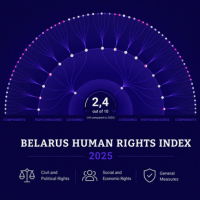
Our analytics is for a better understanding of the trends and situation with human rights in Belarus and for the possibility of monitoring systemic and essential changes, as well as for expanding the human rights focus in related expert spheres (economic, political, social, etc.). It also can be used for justification of positions, opinions, policies, and strategies. // 24.09.2026
Any interaction with the organization (including social media engagement, seeking assistance, or participating in educational activities) may be considered a violation. There is a risk of criminal liability. The law is applied broadly and allows for arbitrary interpretation. If you have interacted with the Belarusian Helsinki Committee, please take steps to ensure your safety. // 23.09.2026
Individual releases and other positive developments do not yet indicate a qualitative change in the human rights situation in Belarus. Repression remains systemic, while becoming less visible and increasingly difficult to monitor. // 19.09.2026
The conclusion of the third cycle of the Universal Periodic Review (2020–2025) and the beginning of the fourth (2025–2030) took place amid a significant decline in the State’s cooperation with international human rights mechanisms. As a result, the UPR has become particularly important as one of the few universal forums in which Belarus continues to participate in international dialogue on human rights. // 05.09.2026
Spoiler: For the first time in seven years, the overall Index score has not declined compared to the previous year. However, this does not mean that the human rights situation has stabilized. Rather, it reflects the effect of approaching the lower limit of the scale. // 02.07.2026